
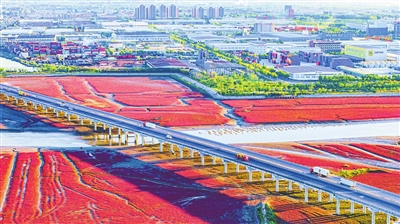
Qingdao, Nov. 4 – The Wuhekou Wetland in the Hongshiya area of the West Coast New Area is currently showcasing its spectacular annual ecological display. Over 500 acres (approximately 3,000 mu) of seepweed have transformed from green to a vibrant red, creating a vast "Red Beach" that stretches from the mudflats to the shores of Jiaozhou Bay. This unique landscape, interwoven with winding tidal creeks and the confluence of five rivers, forms a natural marvel often described as the "Tree of the Earth." This "red secret realm," widely popular on social media, is the result of nine years of dedicated ecological conservation and a testament to the local commitment to ecological values.
Multi-pronged Efforts Revitalize the Tidal Flats
Wuhekou, meaning "the mouth of five rivers," is named for the five waterways that converge into Jiaozhou Bay at this location. Nine years ago, the area suffered from severe salinization due to coastal pollution and poor management. The seepweed was sparse, water quality was poor, and the wetland's ecological functions were in decline. In 2016, local authorities launched a comprehensive ecological restoration project encompassing the sea, land, and rivers, committed to breathing new life into these tidal flats.
Effective ecological restoration requires a long-term strategy. According to staff members, a dedicated management system has been established, with designated personnel forming a multi-layered network to ensure accountability. To further protect the flats, local residents with intimate knowledge of the area have been hired as part of the patrol team, strengthening supervision and guaranteeing the effective implementation of conservation measures.
Pollution control is fundamental to safeguarding the Red Beach. Authorities conduct regular, comprehensive inspections of coastal outfalls and corporate emissions, strictly enforcing compliance with discharge standards. This year alone, relevant departments have patrolled the coastline 20 times, covering a total distance of 13.43 kilometers, identifying and rectifying 19 issues. They have also completed the registration and source-tracking for numerous sea and river discharge points and supported the investigation and remediation of 36 non-compliant sea outfalls, enforcing strict measures to protect the wetland's ecological baseline.
Becoming a Social Media Hotspot
Today, the seepweed in Wuhekou Wetland sprouts in April, grows through spring and summer, and enters its most scenic period from mid-September to late November. The fiery red meadows have become a sought-after "autumn exclusive" for tourists. Moreover, the improved ecological environment has attracted a large number of birds, including egrets, grey herons, and pied avocets, adding vibrant life to the wetlands. In 2021, the area was honored as a provincial-level Ecological Civilization Demonstration Zone for its outstanding conservation work.
The "Red Beach" at Wuhekou Wetland has now become a trendy destination for social media check-ins. On platforms like Douyin and Xiaohongshu, related topics have garnered over 200,000 views. Visitors can be seen admiring the seepweed up close from viewing boardwalks or capturing the magnificent "Tree of the Earth" with drones from above. At sunset, the crimson flats glow in the twilight, creating a breathtaking scene for photography enthusiasts. To accommodate tourists, supporting facilities such as an eco-friendly parking lot and educational signs have been built. The local government also promotes environmental awareness and civilized tourism by organizing photography contests and educational study tours.
(By Guo Nianli, Liu Yameng)
Editor: Yuan Ruichen


