
When evaluating a city's competitiveness from a future perspective, one must look at its economic strength and business environment, but more importantly, at the quality of life created by health & wellness services. The true appeal of a city does not lie in its concrete jungle, but rather in how many lifestyles it can accommodate and how many people's imaginations of a "better life" it can bear.
An 800-kilometer coastline, a pleasant maritime climate, and a multi-dimensional composite ecological resource encompassing "Mountains, Sea, Hot Springs, City, Bay, Islands" collectively endow Qingdao with unique natural advantages for health and wellness. Among China's top 100 health and wellness cities, Qingdao stands out as the only northern city in the top fifteen. However, as high-quality health and wellness services become standard configurations for modern international metropolises, natural endowments do not automatically convert into competitive strengths in city services.
Health and wellness services represent an industry track characterized by a "long slope, thick snow," and, moreover, "a livelihood answer sheet of thousands of households." As Qingdao crafts its new calling card as "China Kangwan" (China Health & Wellness Bay), health and wellness services serve as the crucial stroke.
Backed by the high-end scientific research resources of the University of Health and Rehabilitation Sciences and the life and health industry resources that are poised to step up to a new level of 100 billion yuan, exploring new models for health and wellness services to activate an "all-region health & wellness ecosystem" covering all ages ensures that "China Kangwan" is no longer just an urban ideal, but an aspirational and healthy way of life.
Cultivating the Warmth of Health and Wellness Through Technological Innovation
In Qingdao's blueprint for "China Kangwan," the goal that "the city's life and health industry scale will exceed 100 billion yuan by 2027" acts as a clear quantitative indicator. A competitive life and health industry undoubtedly forms the foundation of "China Kangwan." Nevertheless, the transition of "China Kangwan" from blueprint to reality involves more than mere industrial scale expansion; it more significantly concerns whether a city can explore a brand-new development paradigm for health and wellness services on the strategic track of life and health—a paradigm where technology leads the industry, the industry drives services, and services integrate into society.
Institutional forecasts show that by 2030, China's rehabilitation medical device market size will surpass 300 billion yuan. The industry is currently poised at a pivotal turning point, transitioning from traditional rehabilitation devices to smart and high-end solutions. Qingdao's opportunity lies in deeply linking high-end equipment with end-user health & wellness services to construct a "production-sales closed loop" seamlessly connecting R&D, manufacturing, and application—thereby enabling "smart health & wellness" to ground itself from mere concepts and products into accessible daily services.
The University of Health and Rehabilitation Sciences, inscribed into the national five-year plan three consecutive times, exactly acts as the "smart core" driving Qingdao's industrial upgrade through technological innovation. Yet, associated challenges arise: How can the multidisciplinary advantage of the University of Health and Rehabilitation Sciences be transformed into a precise remedy that suits Qingdao's industrial demands? How can cutting-edge scientific research achievements be rapidly translated into enterprises' product lines to seize the commanding heights in the new arena of global competition? And how can breakthrough technologies like rehabilitation robots, brain-computer interfaces (BCI), and virtual reality rehabilitation walk out of laboratories to undergo testing and continuous iteration in authentic settings such as nursing homes, community health service centers, and home-based health & wellness scenarios? Between the "smart core" and the industrial "body," Qingdao urgently needs to establish more "blood vessels" and "nerves"—using precise and robust technological services as the linkage to rapidly unleash the potential of the University of Health and Rehabilitation Sciences.
Gratifyingly, on the track of rehabilitation medical devices, the innovative forces of "Made in Qingdao" are rapidly converging. A host of innovative products combining artificial intelligence capabilities and rehabilitation functions continually emerge, such as the Haier Exoskeleton Robot, Kangdao Medical Rehabilitation Robot, Longwood Valley Orthopedic Intelligent Surgical Robot, Zhengren Huikang Intelligent Two-Way Nursing Transfer System, and Andepu Technology Intelligent Anti-Bedsore Cushion. Concurrently, the advancing Shandong Rehabilitation (Silver Economy) Industrial Park Pilot Zone successfully undertakes functions including R&D, pilot testing, production, and inspection, delivering a new carrier for the accelerated output of creative achievements throughout Qingdao.
This reveals that Qingdao holds complete capability, relying on its solid manufacturing basis, to carve out an unprecedented path in the scenario innovation of health and wellness services.
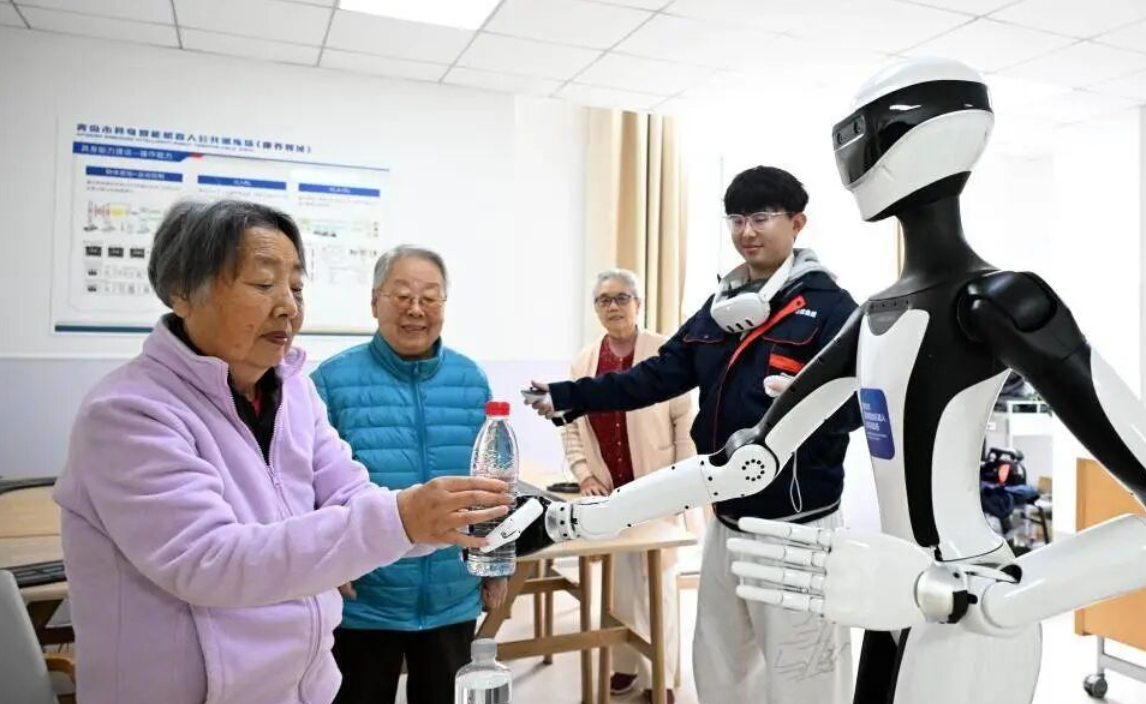
The country's first public training and validation service platform dedicated to health and wellness scenarios established by Qingdao operates as exactly such a carrier, expediting the translation of novel products into new services. Since the Qingdao Training and Validation Center for Embodied Robots and Intelligent Rehabilitation Products in the Health & Elderly Care Field opened earlier this year, 45 enterprises alongside 217 items (sets) of products have entered the training framework. These encompass leading companies such as Haier, Hisense, Guohua, Qingcheng, BrainCo, HIT Tianyu, and Zepu. Within authentic scenarios outlining elderly care and rehabilitation, variant new embodied intelligent products and new technologies undergo the "tempering" of 11 training modules, collecting data during human-robot interaction to attain product iteration and optimization via validation and feedback loops.
If novel technologies intend to genuinely transmute into reliable health and wellness services, addressing the cognitive gap between supply and demand sides is necessary. The supply-side products must decipher precise health and wellness necessities, while demand-side elderly care institutions must alleviate any cognitive ambiguity regarding what services such intelligent artifacts can offer. The Training and Validation Center fittingly bridges the gap linking "intelligent hardware" and "service quality"—it embeds intelligent rehabilitation mechanisms directly within real service settings, compelling developers and service providers to persistently calibrate attributes and refine the caregiving process via practical action. Consequently, it achieves a dual catalysis for upgrading hardware capacity and iteratively elevating service quality. The Training and Validation Center has preliminarily demonstrated this positive effect. Over several short months, the center not only incubated pristine products such as intelligent companion robots and all-in-one safety devices for elderly care institutions, but has also let nursing homes vividly grasp the service prowess of these embodied intelligent health and wellness applications, prompting distinct procurement intentions.
The sustained surge in necessities relating to health and wellness presents infinite possibilities for Qingdao to steer service advancement directed by technological creation, executing a glorious paradigm shift from an "equipment supplier" to a "service enabler." Capturing this critical window, banking upon the smart-core effect from the University of Health and Rehabilitation Sciences combined with the solid prop furnished by manufacturing clusters, promoting the innovation of health & wellness service models to culminate a definitive closed loop geared firmly toward health & wellness quality improvement, "China Kangwan" holds a total promise—via a breakthrough practice—to contribute a profoundly demonstrative "Qingdao Approach" to the nation.


